Game theory and Monty Hall, the predictive intelligence stack, and pulling signal from noise — transcribed from live whiteboard sessions.
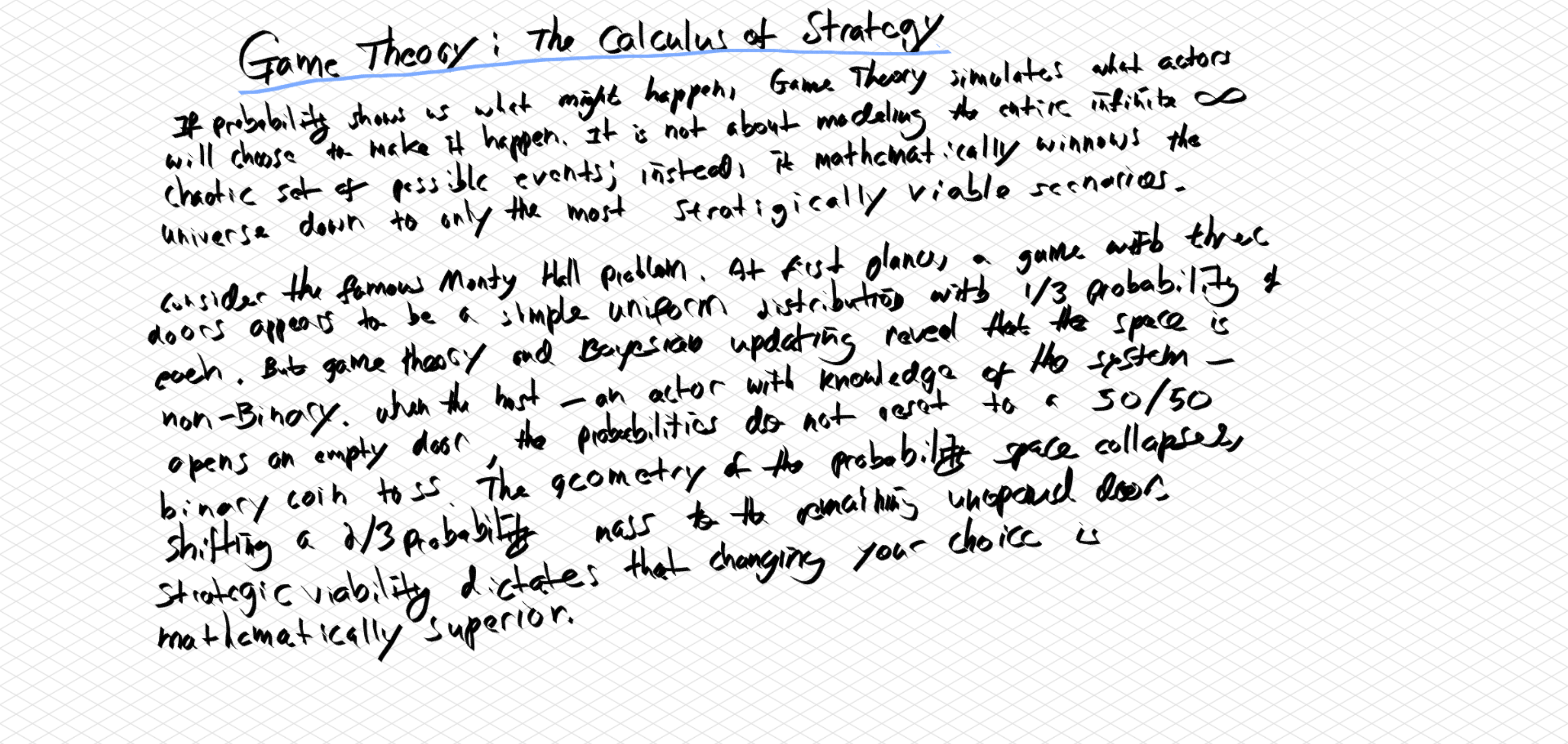
If probability shows us what might happen, Game Theory simulates what actors will choose to make it happen. It is not about modeling the entire infinite chaotic set of possible events; instead, it mathematically winnows the universe down to only the most strategically viable scenarios.
Consider the famous Monty Hall problem. At first glance, a game with three doors appears to be a simple uniform distribution with 1/3 probability for each. But game theory and Bayesian updating reveal that the space is non-binary. When the host — an actor with knowledge of the system — opens an empty door, the probabilities do not reset to a 50/50 binary coin toss. The geometry of the probability space collapses, shifting a 2/3 probability mass to the remaining unopened door. Strategic viability dictates that changing your choice is mathematically superior.
Prior belief that the prize is behind door \(i\):
$$P(C_i)=1/3$$
After the host opens an empty door, switching wins with probability:
$$2/3$$
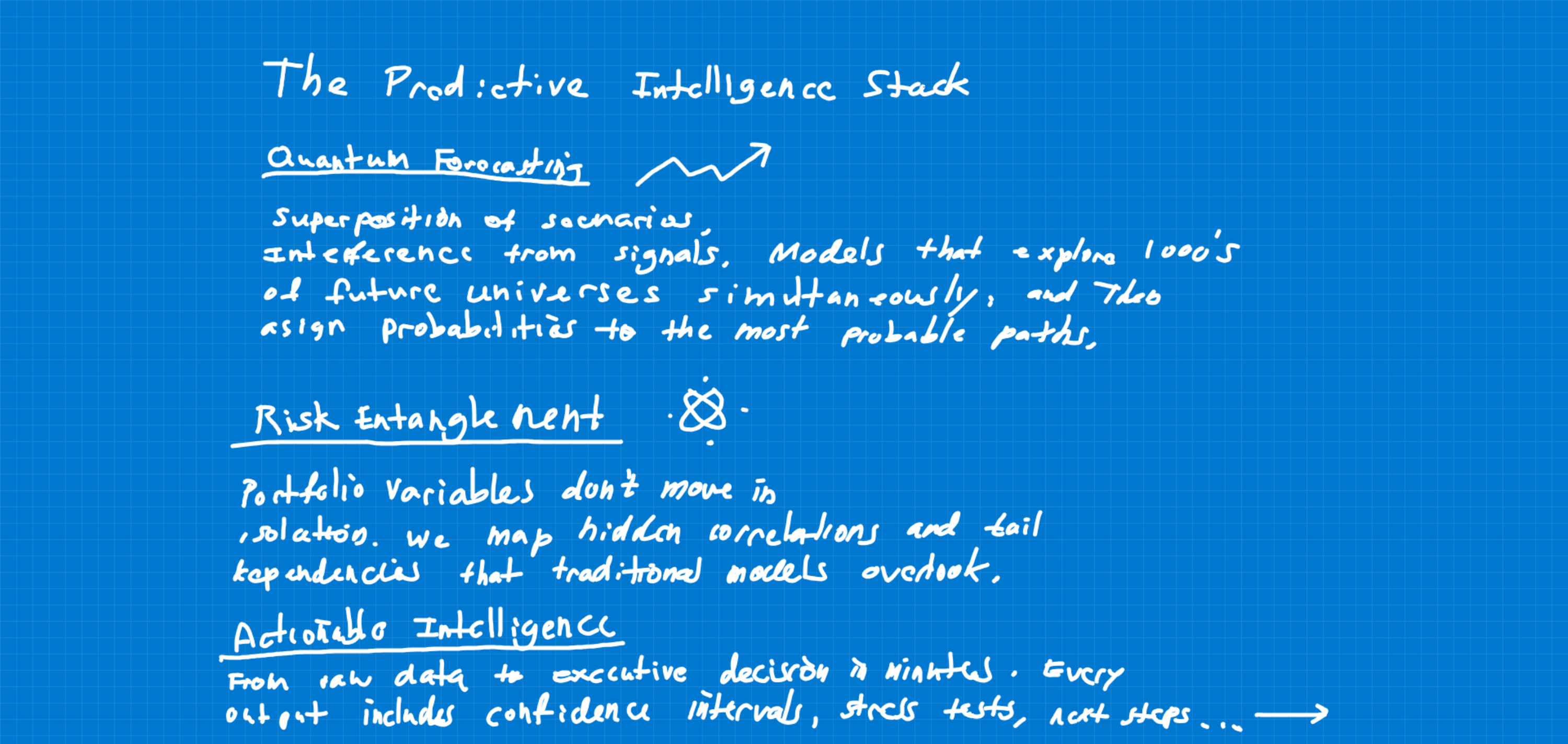
Superposition of scenarios, interference from signals. Models that explore thousands of future universes simultaneously, then assign probabilities to the most probable paths.
Portfolio variables don't move in isolation. We map hidden correlations and tail dependencies that traditional models overlook.
From raw data to executive decision in minutes. Every output includes confidence intervals, stress tests, and next steps.
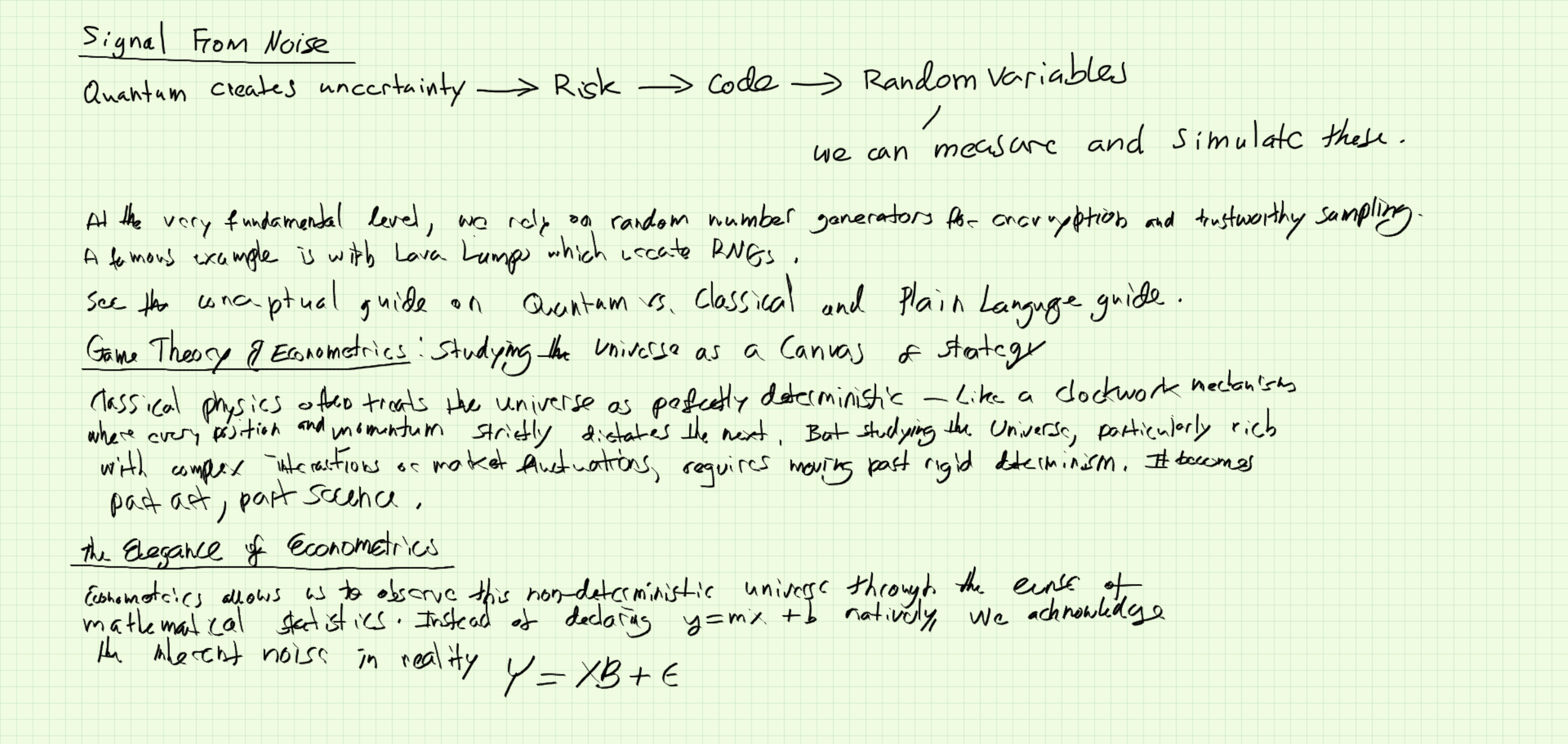
Quantum creates uncertainty → Risk → Code → Random Variables (we can measure and simulate these). Random number generators power encryption and trustworthy sampling — from algorithmic PRNGs to physical entropy sources like lava lamps. Explore related notes on quantum / qubits and language.
Studying the universe as a canvas of strategy; move past rigid determinism; part art, part science.
Instead of declaring $$y = mx + b$$ natively, acknowledge noise:
$$Y = X\beta + \varepsilon$$
(matrix form of the linear model with an error term).