In 2017, my office was in the Prudential Tower. The following year, I was hired to work in the office next door—just steps away through the mall. Soon after, I worked for Milliman IntelliScript in Chicago in the heart of downtown, mere steps from the iconic Willis Tower, which rises 1,451 feet into the sky. A key fact about Chicago's business district, often referred to as the Loop, is that it is home to the Chicago Board of Trade (CBOT), established in 1848, one of the world's oldest futures and options exchanges. Located at 141 W Jackson Blvd, the CBOT is a National Historic Landmark and a central hub for global commodities trading, significantly shaping Chicago's financial prominence.
Later, I was accepted into the Capital Factory Startup program which is the most active venture capital investor in Texas since 2010, according to Pitchbook, supporting over 1,789 startups through investments, mentorship, and coworking space in its 81,000-square-foot facility in downtown Austin. As a founder and CEO, I collaborated with business leaders from around the world and found myself on stage pitching to venture capitalists.
Then, in 2023, I worked at Expedia Group and contributed to projects in an innovative tech environment. Nestled in Austin’s vibrant Domain, a sleek, tech-driven neighborhood named for internet domains, Expedia Group’s office buzzed with innovation. This modern hub, home to tech giants like Meta and Google, pulsed with energy. Just a short drive away in Round Rock stood Dell Technologies’ headquarters.
Predictive analytics provides us with a powerful tool to avoid such costly mistakes. Instead of merely reflecting on past events, predictive analytics enables us to forecast future trends, empowering smarter, proactive decisions across industries including finance, healthcare, cybersecurity, and beyond. With precise predictions, organizations can confidently navigate uncertainty, turning potential challenges into strategic advantages.
Visit The Official Website:
www.PredictiveInsightsAI.com
Through this book, you’ll gain practical insights into predictive analytics, machine learning, and AI—equipping you with the skills necessary not just to understand, but to shape the future.
This book is more than just a technical manual; it’s a roadmap for anyone preparing for the Society of Actuaries’ Predictive Analytics (Exam PA) or seeking to master risk modeling in a rapidly evolving world. Over the years, I’ve had the privilege of teaching and mentoring over 500 paying actuarial students and thousands of online readers, including professionals at leading insurance carriers and global consulting firms. My students’ success stories—from passing Exam PA to advancing their careers at top-tier firms—are a testament to the effectiveness of the step-by-step approach and real-world case studies featured in these pages.
Inside, you’ll find:
A complete Predictive Analytics study guide: Comprehensive coverage of the syllabus, structured lessons, and exam-style practice questions, all designed to build your confidence and mastery.
Hands-on predictive analytics: Practical walkthroughs using R, Python, and industry-standard tools, so you can apply what you learn immediately.
Risk modeling fundamentals: Clear explanations of key concepts in statistics, data science, and actuarial modeling, with a focus on real-world application.
AI and machine learning for actuaries: Demystifying modern techniques and showing how they fit into the actuarial toolkit.
Career insights: Advice on navigating the actuarial credentialing process, building your professional brand, and thriving in a data-driven workplace.
My own journey toward actuarial credentials was filled with challenges, late nights, and hard-won breakthroughs. I know firsthand how daunting the path can be—but I also know the rewards that come from mastering these skills and earning your credential. This book distills everything I’ve learned from years of teaching, consulting, and working on the front lines of predictive analytics, so you can avoid common pitfalls and accelerate your own progress.
Whether you’re just beginning your actuarial journey or looking to sharpen your predictive analytics expertise, this book is your trusted companion. Advance your career, and make a lasting impact in the world of data-driven decision making.
When a nurse or engineer makes a mistake, bridges come crashing down or people could lose their lives, but predictive analytics mistakes are equally costly. Actuaries work with financial values in the millions and billions of dollars. One small error or one mistyped parameter can spell financial disaster. For this reason, errors are not an option. If something goes wrong, hundreds of man-hours will be spent re-doing the calculation until it is corrected.
This is why the Predictive Analytics exam from the Society of Actuaries is so difficult to pass. The SOA doesn’t want actuaries who don’t fully understand predictive modeling to be using them in real life. Only the top 50% who truly master the material are given a passing grade.
At www.PredictiveInsightsAI.com, we have been coaching actuaries who are studying for this exam a 5-hour long test similar to a Kaggle competition. People spend 4-6 months preparing but only 50% pass.
If you’re preparing for Exam PA, you can pass on your first attempt by avoiding these common mistakes that we’ve noticed from coaching hundreds of actuaries at ExamPA.net. If you already use predictive models, you can reduce the risk of something going wrong. The SOA even has a special name for this process of reducing errors known as “model governance”.
Download the Datasets:
From HuggingFace:
https://huggingface.co/supersam7
Code used to write this book: https://github.com/sdcastillo/PA-R-Study-Manual
CONTACT ME:
▶️ YouTube: https://www.youtube.com/@predictiveanalyst
LinkedIn (company): https://www.linkedin.com/company/70938511/
✉️ Email: ExamPATutor@gmail.com
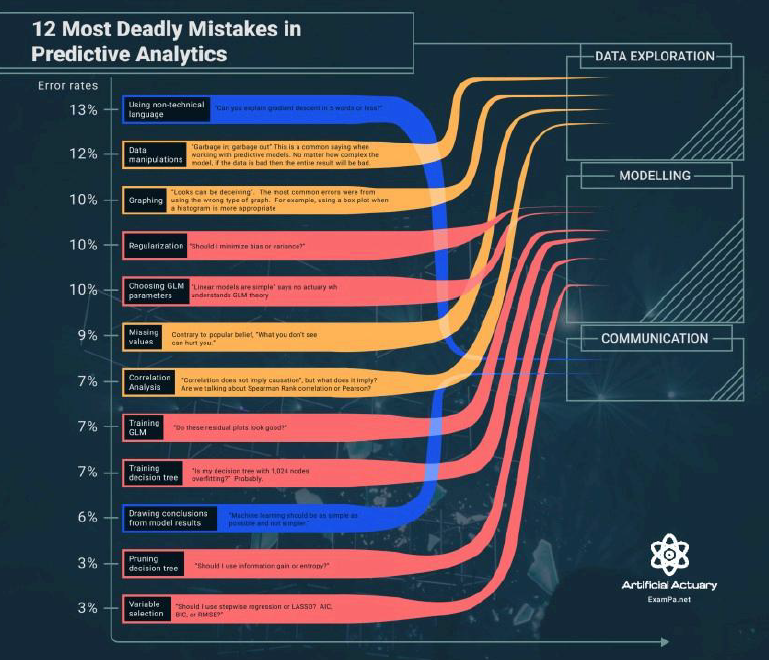
Seven common Exam PA mistakes
- Poor communication skills
Many people lose points on communication questions. This can be either using technical language when the audience is intended to be non-technical, such as a Sales or Marketing manager, or using technical language inappropriately. As an Actuarial Analyst, you are trained to be technical, but this exam tests your soft skills as much as it does your statistical chops.
One person was telling others how they scored well on the communication questions:
I remember the prompt was something like "remember, you are giving guidance, not giving them a model. From that, I only spent maybe one or two sentences talking about the model at all and the rest of the time talking about the impact of each significant variable."
This is an excellent example of talking about what your model does instead of how it does it. Actuaries often lose their audience by talking about technical details when all that the audience cares about is the benefit.
- Failing to explain their models clearly
Regardless of if you’re using a neural network or a decision tree, people like to see how your model “thinks”. This person scored very well on the communication questions by showing examples.
I received a 9 [out of 10] ... Made a table, one column for each factor and change in probability at the end, then changed one factor at a time in each row to show how the probabilities changed.
Earning 9 out of 10 points is a great score. Here’s an example of what this person is talking about. The model is predicting whether or not a person will be profitable for a health insurance company. The target variable is “Probability of High Profit”. Based on the person’s age, years of education, marital status, and hours worked per week, there is a prediction for the profitability of being high or low.
The first policyholder is 39 years old, has a high school education, is married, and works 35 hours per week. This person is profitable, perhaps because they are careful about their health and see a doctor annually.
The second policyholder is a few years older, so they are at a higher health risk, and so they will likely need to have more medical procedures done and so their profitability is slightly lower.
The third policyholder may be at a higher risk because they work long workweeks of 50 hours
Age Years of Education Marital Status Hours Worked Per Week Probability of High Profit 39 12 Married 35 60% 53 18 Married 40 45% 25 16 Never Married 50 20%
- Making mistakes during data manipulation
Data Manipulation is always a source of mistakes, and to make this double-painful, a mistake on the data manipulation has a chain-reaction effect of causing future model results to be incorrect. A common saying is “garbage in; garbage out” because no matter how powerful your machine learning algorithm is, if you put in bad data then you will get a bad result.
Here’s what one person said who failed that:
It appears that I did something very wrong on in training the GLM ... I didn't expect that. I must have done something very dumb, like overlooking partitioning the data, and training on the training set?
They failed because they evaluated their model on the same data that it was trained on. Every data scientist knows that this leads to unrealistic model results, so how could such a mistake go unnoticed?
This type of mistake is common in other disciplines as well. Chess players are familiar with the concept of a “blunder”, which is when a player makes a very bad move that is usually due to carelessness or overconfidence. The key to avoiding these mistakes is practice, practice, and more practice. In chess, this takes the form of “tactical exercises”, which are mini scenarios which usually have only one correct move. For actuaries using predictive analytics, exam PA’s problems give you feedback to quickly improve.
- Not prioritizing time effectively
The exam is 5 hours and 15 minutes long, but almost everyone who takes it reports running out of time before completing everything. The exam has 12 separate tasks, and each count for between 3 – 20 points of the total grade. People often spend too much time on the low-priority tasks and not enough time on the important ones.
The entire report that you’ll need to write will be close to 20 pages. For those who don’t have English as their first language, this time factor becomes even more critical. Strategies which you can use to be more efficient with time are:
Start lean and then add complexity as you have time. When modeling, first fit a model using only one or two variables. Then set up a working data pipeline and cross-validation strategy. Then add more complexity as time permits.
Schedule your tasks and the order by priority so that the first item is the most important
Use a timer! When studying for Exam PA, set a timer and practice under the real 5-hours-15-minute limit.
Treat your time like money – because it is! For exam PA, you have 315 minutes and there are about 12 questions. If a task is only worth 5 points, then you should only give it 5% of your time, or about 16 minutes.
- Studying too much and not doing enough practice
Knowledge without experience is useless. Many people spend 200-300 hours studying machine learning theory but then fail because they lack sufficient experience. Actuaries are familiar with the “been there; done that” rule which says that when taking an exam, you never want to be caught by surprise but should always be able to say “I’ve been there and I’ve done that before”.
- Thinking only about the statistics and not the business context
Every model has advantages and disadvantages. There are no “silver bullet” algorithms. Some people say that a GBM is the closest thing to this, but this only makes sense if we are only considering the model’s performance. On Exam PA, you learn not only the statistical pros and cons, but also the business and IT-related ones.
Here are a few examples for the humble Decision Tree. There are similar lists for GBMs, Random Forests, as well as Linear Models. The non-statistical considerations are in bold.
Advantages:
Easy to interpret in a spreadsheet format using simple yes/no questions. Trees can even be translated into SQL queries to be scored over big databases;
Captures interaction effects and non-linearities;
Handles missing values;
Performs variable selection.
Disadvantages:
Is a “weak learner” because of low predictive power;
Is often a simplification of the underlying process because all observations at terminal nodes have equal predicted values. This can result in “stepwise” predictions which can be undesirable for some applications;
High variance (which can be alleviated with stricter parameters) leads the “easy to interpret results” to change upon retraining;
Unable to predict beyond the range of the training data for regression because each predicted value is an average of training samples.
- Making bad statistical assumptions
Did you notice that this was last on the list? While the stats are really important, it’s often the softer skills which actuaries overlook when using predictive analytics. It can be easy to forget that we are just trying to solve a problem and that statistics is just a tool that we use.
Another name for machine learning, which I personally prefer, is “statistical learning”, which Wikipedia defines as
“Statistical learning theory is a framework for machine learning drawing from the fields of statistics and functional analysis.”
It’s just math! And actuaries are good at math. Actuaries and actuarial analysts are among the best-qualified professionals to make use of today’s modern machine learning and AI tools because of their rigorous background in applied math and statistics.
All of that being said, one of the most common reasons for failing Exam PA is misunderstanding the statistical theory. When we feel overwhelmed with information, it’s tempting to rely on memorization, but this will always lead to failure when they encounter problems that we have not seen before. Some common examples from Exam PA are:
Confusing a GLM (Generalized Linear Model) with general linear models (a.k.a., multiple linear regression models).
Peeking at the test set error. People overfit their models by choosing parameters which give them the lowest test set error, which makes the train-test splitting process completely useless.
Oversimplifying complex models. Yes, a GBM or Random Forest can show you partial dependence plots, but these are just averages and are often misleading. Similarly, variable importance measures are often assumed to be valid even when the performance of the model is poor – a ridiculous assumption!
Adjusting a variable for skewness multiple times, first by taking the log, and then again by using the log link function in a Generalized Linear Model (GLM).
Misusing performance metrics such as R-Squared, RMSE, MAE, Log-likelihood, AIC, BIC, or others. Everyone knows R-Squared, but what about Mean Absolute Percent Error (MAPE) or the Pearson Goodness of Fit statistic? Is a lower AIC better than a higher AIC? Can I use R-Squared for a GBM? Yes, and yes, but it’s easy to forget these things.
Misinterpreting confusion matrices. There is a reason why they’re called this – they are confusing!